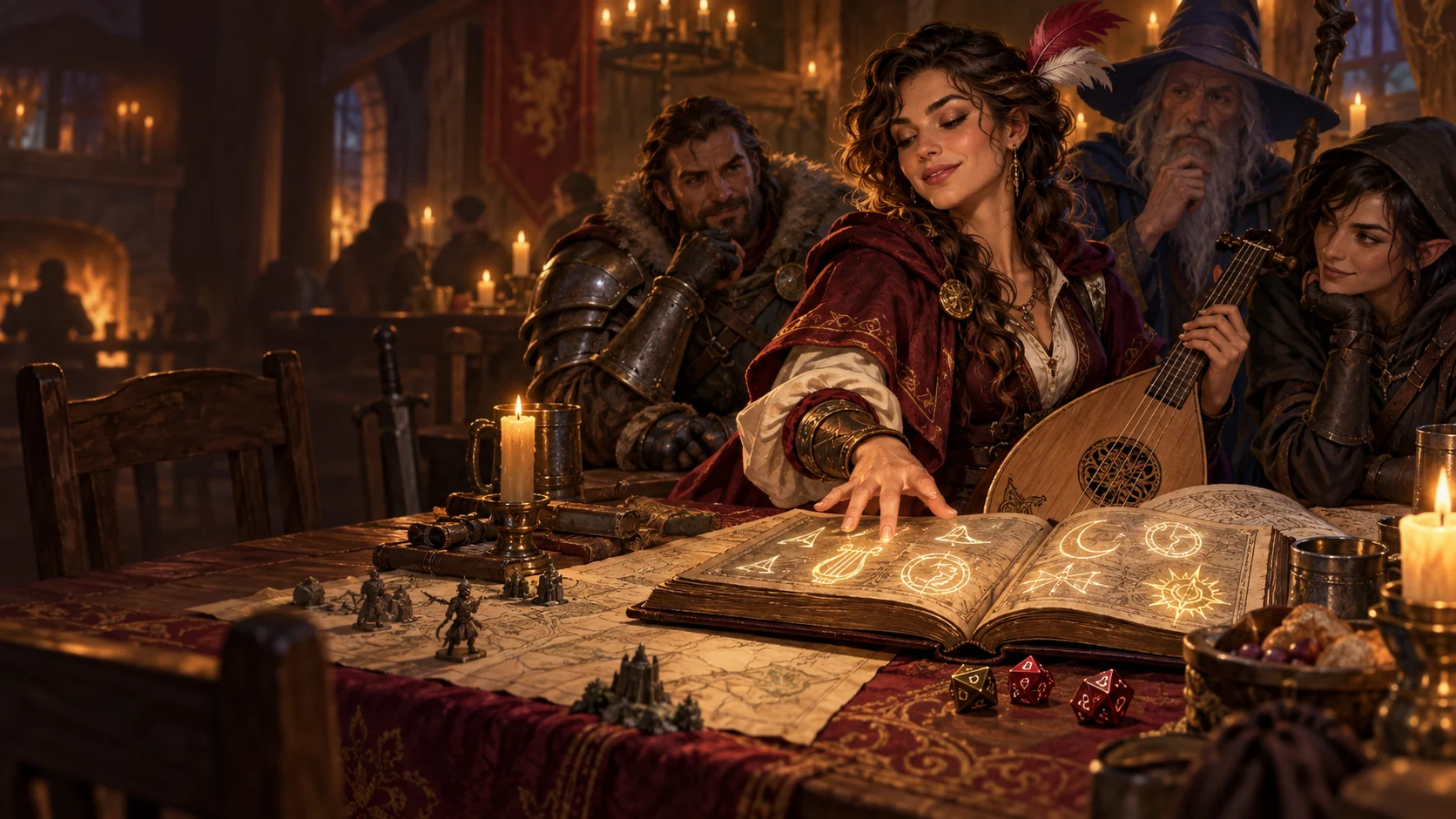
Bards are often called versatile spellcasters, but versatility only helps when the spell list has a clear purpose. A character who prepares or knows a little damage, a little healing, a little control, and a little utility can still feel unprepared if every option competes for the same action or concentration slot.
A better approach is to build a spell toolkit. Decide what you want to do when the party enters combat, when an ally drops to zero hit points, when a group of enemies blocks a corridor, and when the adventure becomes a social or exploration challenge. The best Bard spells for 5e are different for a small party with no dedicated healer than for a large group that already has strong control and recovery.
This article uses familiar 2014-style spell names as examples, while calling out where updated rules or another source book may change the answer. Always use the spell text approved by your Game Master. For a broader class overview, see our Bard 5e guide; for the physical side of a class-themed product line, visit our character class dice page.
How to choose the best Bard spells in 5e
Before comparing individual spells, score each candidate against five practical questions:
- What job does it perform? A spell should support, control, damage, defend, move, reveal information, or solve a social problem.
- What does it compete with? Check whether it uses an action, bonus action, reaction, or concentration. A great spell that always conflicts with your main action may be less useful than a slightly weaker flexible option.
- How often will it work? Range, line of sight, saving throw, creature type, immunity, and environment all affect reliability.
- What happens when it fails? A spell that still creates value on a successful save may be safer than one that does nothing.
- Does the party already cover this job? Bards gain value by filling a gap, not by duplicating a specialist unless the campaign strongly rewards redundancy.
Also separate spells known or prepared from spells available in a source book. A recommendation list can be correct for one Bard, one level, or one rules edition and still be a poor fit for another character. Check the level requirement, casting time, concentration, components, duration, and whether the effect scales before you lock in the choice.
Best Bard cantrips for reliable utility
Cantrips are the part of a Bard spell list that you use repeatedly, so prioritize a dependable combat fallback and utility that creates new options. You do not need four damage cantrips. You need ways to contribute when spell slots are low, concentration is occupied, or the ideal spell has the wrong range.
Vicious Mockery: defensive damage with a purpose
Vicious Mockery is a familiar Bard cantrip because it combines psychic damage with a defensive rider when the target fails its save. Its value is not only the damage. Disadvantage on the next attack can reduce incoming pressure against a vulnerable ally, especially when the target has a strong attack but the party cannot remove it this round.
Use it when protecting an ally matters more than maximizing your own damage. It is less attractive against creatures with strong Wisdom saves, psychic resistance, or several weak attacks where the rider changes only one roll. As with every cantrip, check the current wording for the rules version at your table.
Minor Illusion: a small spell with a large decision space
Minor Illusion can create a sound or a visual illusion that supports distraction, misdirection, cover for a plan, or a believable social detail. It is strongest when the player describes a concrete purpose rather than asking for a vague illusion. A guard hearing a familiar voice, a party hiding behind a false crate, or a room gaining a believable background sound can all create an opening, but the Game Master decides how creatures interact with the illusion.
Mage Hand and Message: tools for positioning and information
Mage Hand lets the Bard manipulate objects at a distance and can make a trap, latch, or suspicious container safer to test. Message supports quiet coordination when the party must split, negotiate, or move through a guarded area. These cantrips may feel less dramatic than a damage roll, but they are useful in the exact scenes where a Bard's flexible skill set should matter.

Best 1st-level Bard spells
At 1st level, spell slots are limited and many characters have low hit points. Choose spells that remain useful outside a perfect combat scenario. A good first-level Bard spell either changes the action economy, protects a teammate, or solves an obstacle without requiring a high-level slot.
Healing Word: emergency recovery at range
Healing Word is valuable because it uses a bonus action and works at range. It is not usually the most efficient way to restore hit points after a fight, but it can return an unconscious ally to the encounter while leaving the Bard's action available for movement, a cantrip, an object interaction, or another tactical choice.
Its strongest use is timing, not raw healing. Cast it when an ally's return changes the round: a front-line character can block a passage, a fallen controller can maintain a plan, or a teammate can reach an objective. Track the action and bonus-action conflict carefully; a Bard who needs the bonus action for another feature may prefer a different turn.
Dissonant Whispers: damage plus forced movement pressure
Dissonant Whispers is more than a damage spell. When the target fails its save, the forced movement can create opportunity attacks from nearby allies. That makes the spell better when your party has melee characters ready to punish the target for leaving reach. It is less impressive when the target is isolated, immune to the relevant effect, or positioned where movement gives it a better tactical location.
Faerie Fire: accuracy for the whole party
Faerie Fire can turn one successful area placement into a party-wide accuracy advantage against visible targets. It is especially useful for groups that rely on attack rolls and for encounters where concealment or invisibility is interfering with normal targeting. The tradeoff is concentration and a Dexterity save, so place it where it helps more than one ally without catching your own team.
Charm Person, Tasha's Hideous Laughter, and Feather Fall
Charm Person can support an intrigue-heavy campaign, but its social aftermath matters. The target may know it was charmed when the effect ends, depending on the spell text, so it is not a universal solution to every negotiation. Tasha's Hideous Laughter can remove one creature from a fight when it fails, making it more suitable for a priority target than a crowd. Feather Fall is a narrow defensive spell, but when the campaign includes cliffs, collapsing structures, or flying characters, its reaction timing can prevent a disastrous fall.
Best 2nd- to 5th-level Bard spells
Middle levels are where Bard spell choices begin to shape an entire encounter. The right choice usually reduces enemy actions, gives the party a safe route, or makes a difficult scene much easier. Keep the party's saving throw profile and common environments in mind.
Suggestion: solve the problem instead of trading hit points
Suggestion rewards specific, believable instructions. It can influence a creature in a negotiation, redirect a guard, or encourage an enemy to leave a dangerous position, but it is not mind control with no limits. The request must be phrased in a way the target can interpret as reasonable under the spell's rules. The best Bard players present a clear action and explain why it sounds plausible in the fiction.
Invisibility and Greater Invisibility: different jobs
Invisibility is often an exploration and positioning spell: scout a route, bypass attention, or help an ally reach a better location. Greater Invisibility is more valuable in a fight because the effect can remain relevant while the target attacks or casts, subject to the current spell text. Both require concentration in familiar versions, so decide whether concealment is more valuable than control before casting.
Heat Metal: strong when the target cannot drop the item
Heat Metal can be highly effective against an armored creature or an enemy holding a metal object. The spell becomes less useful when the campaign rarely features metal equipment, when the target can drop the item without meaningful cost, or when maintaining concentration prevents a better control spell. It is a classic example of a spell whose ranking depends on the adventure rather than on a universal tier list.
Hypnotic Pattern and Fear: group control
Hypnotic Pattern can pause several creatures at once and create a powerful swing when the party can isolate, reposition, or defeat part of the encounter. Its area placement requires care because friendly fire and line of sight can decide whether the spell is brilliant or unusable. Fear changes movement and can scatter enemies, but the map matters: a fleeing target may run toward another threat, leave cover, or create a new problem.
Dispel Magic: answer the effect that is already winning
Dispel Magic is rarely exciting before the table sees a magical barrier, charm, hazard, summoned effect, or enemy buff. Once that effect blocks the party's plan, Dispel Magic can be the most important spell on the list. It rewards a Bard who asks what is actually controlling the encounter instead of spending every turn on damage.
Polymorph and Dimension Door: large tactical changes
Polymorph can rescue an ally, remove an enemy from a fight for a time, or create a new physical solution, but the target's new form and the spell's concentration requirement must be tracked carefully. Dimension Door gives the party a long-range repositioning option that can bypass a wall, escape a collapsing scene, or move an ally who cannot reach safety on foot. The best use is often to change the battlefield rather than to chase a small numerical advantage.
Best high-level Bard spells
At higher levels, spell slots are expensive but the problems are larger. Choose high-level spells that can change the outcome of a major scene, not just add a little more damage to an ordinary round.
Hold Monster: a high-value single-target lock
Hold Monster can be devastating when the target fails its save and the party is positioned to exploit the condition. Melee attacks may gain additional value against a paralyzed target under the current rules, but the spell is still a concentration commitment and many creatures have strong saves or immunities. Use it when removing one dangerous enemy's turn is worth the slot and the party can capitalize immediately.
Mass Suggestion: social and tactical influence at scale
Mass Suggestion can be one of the best Bard spells for a campaign built around diplomacy, infiltration, or complex enemy groups. It can also create a nonviolent solution to a large encounter when the request is plausible. The spell asks more from the player's wording and the Game Master's adjudication than a simple damage spell, so use precise language and respect the target's motives.
Otto's Irresistible Dance and other capstone choices
Otto's Irresistible Dance is a memorable control spell for a key creature, but its value depends on the target's action options, saving throw, and whether the party can keep the target within reach. Other high-level choices may come from the Bard's core list, a permitted supplement, or Magical Secrets. Treat Magical Secrets as a chance to solve a real party gap rather than an invitation to copy the most famous spell in another class.
Bard spell packages by party role
Instead of memorizing one ranking, build a package for the campaign you are actually playing:
| Party need | Spell direction | What to check |
|---|---|---|
| Emergency support | Healing Word, defensive reactions, recovery utility | Bonus-action conflicts, range, timing, and whether an ally can act after returning. |
| Group control | Faerie Fire, Hypnotic Pattern, Fear | Concentration, area placement, friendly fire, and enemy saving throws. |
| Single-target pressure | Dissonant Whispers, Tasha's Hideous Laughter, Hold Monster | Save type, immunity, ally positioning, and what happens if the target succeeds. |
| Social campaign | Charm Person, Suggestion, Invisibility, Mass Suggestion | Believable wording, duration, social consequences, and the target's motivations. |
| Exploration and escape | Mage Hand, Message, Dimension Door, Feather Fall | Range, line of sight, reaction timing, carrying limits, and terrain. |
| Missing magical answers | Dispel Magic, information spells, or a Magical Secrets choice | Which effect is blocking the party and whether another character already covers it. |
For a game store or dice brand, these role categories are also useful product categories. A Bard-themed set can use readable number fills, musical or arcane motifs, and a coordinated package without claiming that one class has one mandatory color. Our character class dice guide explains how class identity can become a retail-friendly series, while the custom RPG dice page covers colors, symbols, packaging, and sampling.
Concentration and action economy: the hidden ranking system
Many “best Bard spell” lists underrate the cost of concentration. You can normally maintain only one concentration spell, and taking damage can force a concentration check. If Hypnotic Pattern, Greater Invisibility, and Polymorph are all in your spell list, they are not three simultaneous tools. They are three different answers competing for one slot.
Build a fallback plan for the round after you cast concentration. Vicious Mockery, a weapon attack, a skill action, Bardic Inspiration, movement, or a non-concentration spell can all be correct depending on your character. Position behind cover or durable allies, avoid standing where every enemy can reach you, and remember that moving before danger arrives is often better than spending a spell to repair a preventable problem.
Action economy matters in the same way. Healing Word is attractive because it uses a bonus action, but it can conflict with another feature. Dissonant Whispers uses an action but may generate allied opportunity attacks. A reaction spell may save a turn but prevents another reaction. Write down the action type beside your most-used spells so you can decide quickly at the table.
2014 Bard spells versus updated rules
Do not assume that a spell recommendation carries across rules versions without checking. The 2014 and updated Bard may use different class features, subclass wording, spell access, and interactions with d20 tests. Even when a spell name is familiar, the casting details or condition language may have changed.
Before a campaign begins, record the following:
- Which Player's Handbook or rules reference controls the Bard class.
- Which spell list and source books are allowed.
- Whether a spell is known, prepared, granted by a feature, or selected through Magical Secrets.
- How the Game Master handles ambiguous targets, social wording, and line of sight.
- Which physical dice or digital tool you will use for attack rolls, saves, damage, and Bardic Inspiration.
The official free Bard rules and the rule source chosen by your table should take priority over any third-party ranking. If you need a quick way to practice spell attacks, saving throws, damage, advantage, and disadvantage, use our online 5e dice roller.
Best Bard spells for 5e FAQ
What are the best Bard spells for 5e?
Start with spells that cover your party's missing jobs. Healing Word, Dissonant Whispers, Suggestion, Hypnotic Pattern, Dispel Magic, and Dimension Door are strong examples because they solve different problems. The best choice still depends on level, ruleset, party composition, and campaign environment.
What are the best Bard cantrips?
Vicious Mockery provides a defensive combat option, while Minor Illusion, Mage Hand, and Message provide utility. Choose a mix that gives you something useful when spell slots or concentration are unavailable.
Which Bard spells need concentration?
Many high-impact options do, including Faerie Fire, Invisibility, Hypnotic Pattern, Fear, Greater Invisibility, Polymorph, and Hold Monster in familiar spell lists. Read the exact spell text and plan a non-concentration fallback.
Are Bard spells the same in 2014 and updated rules?
No. Confirm the class, source books, spell list, and spell wording used by your group. Avoid combining a 2014 feature with an updated spell interaction unless the Game Master allows it.
How should a Bard choose spells for a small party?
Cover emergency recovery, one reliable control option, a social or exploration tool, and a way to keep contributing while concentration is active. A small party usually benefits more from coverage than from stacking several versions of the same effect.
What dice does a Bard need?
A standard seven-piece polyhedral dice set handles common Bard rolls. Extra d6 dice are useful for tracking Bardic Inspiration when the current die is a d6, and a digital roller can help practice saving throws and spell attacks.
Continue building the Bard and the dice setup.
Bard 5e Guide
Review Bard ability scores, Bardic Inspiration, colleges, play strategy, hit dice, and character choices.
Character Class Dice
Explore Bard, Wizard, Rogue, Paladin, Druid, Fighter, and other class-themed product directions.
Online 5e Dice Roller
Practice spell attacks, saving throws, damage, advantage, disadvantage, and resource rolls.
Create a Bard or character-class dice collection.
Share your target material, quantity, theme, number fill, packaging direction, and delivery market. We can recommend catalog samples or discuss a custom class-themed RPG dice program.
Final Bard spell checklist
Choose a clear party role, verify the ruleset, and build coverage across support, control, utility, and defense. Track concentration and action types before the session. Keep at least one useful non-concentration fallback, and select spells for the encounters your campaign actually presents. The strongest Bard spell list is not the one with the longest ranking; it is the one that gives the party a good answer when the plan changes.