Custom dice are one of the most common physical upgrades for tabletop RPG projects because they are easy for backers to understand. A dice set can support a character class, faction, monster, map region, magic school, or limited collector tier. The challenge is that dice also introduce real manufacturing choices: material, finish, readability, packaging size, MOQ, sampling, production time, and shipping weight.
If those details are handled late, the campaign team can end up with unclear reward costs, weak stretch goal math, or a product that looks good in a render but is hard to manufacture consistently. The goal is not only to choose attractive dice. The goal is to choose dice that fit the campaign promise, margin, timeline, and fulfillment method.
Custom dice for Kickstarter RPG campaigns: the quick answer
For most first-time RPG campaigns, start with a custom 7-piece polyhedral dice set in resin or acrylic style, confirm the concept with a sample kit, then upgrade to sharp edge resin, metal dice, oversized d20, or premium packaging only when the pledge tier can absorb the cost. Use custom faces and logo dice carefully: one readable symbol on the highest face is usually easier to approve than complex art on every die.
A useful supplier brief should include the dice material, color palette, number fill, any custom d20 face, estimated quantity, packaging format, delivery country, target launch date, and whether the dice are intended as an add-on, stretch goal, deluxe reward, or retail product after the campaign.
1. Decide what role the dice play in the campaign
Before discussing colors or molds, decide how the dice will be sold. The same dice set can make sense in one reward role and fail in another.
| Campaign use | Best dice direction | Buyer risk to check |
|---|---|---|
| Add-on item | Resin or acrylic-style 7-piece sets with clear theme colors | Keep packaging compact and shipping weight predictable |
| Stretch goal | Unlocked colorway, custom d20 face, or upgraded number fill | Do not unlock a design that changes MOQ or production time too much |
| Deluxe reward tier | Sharp edge resin, metal dice, liquid core, or collector box | Confirm samples before promising exact finish and weight |
| Retail follow-up | Private label packaging with barcode-ready box or display format | Plan reorder SKU codes and packaging before retail outreach |
Creators often want one spectacular dice set for every purpose. In practice, a simple resin set may work better as a low-friction add-on, while a heavier metal set may work better as a deluxe pledge upgrade. Separate these roles early so the quote reflects the real use case.
2. Match the dice material to pledge tier and audience
Material affects perceived value, production cost, defect tolerance, shipping weight, and the kind of artwork that looks good. Resin dice are flexible for color swirls, inclusions, class themes, elemental themes, and fantasy campaign palettes. They are often the most practical starting point for RPG creators who need a custom look without turning dice into the main production risk.
Sharp edge resin dice can feel more premium and photograph well for collector tiers, but they require careful sample review for edge finish, number clarity, and polish quality. Metal dice are excellent for high-value backer rewards, dragon themes, faction coins, dark fantasy settings, or limited editions. They also add shipping weight and usually need stronger packaging. Oversized d20 dice can work as a convention item, display reward, or limited collector piece, but they should not be treated like a normal dice set in cost planning.
3. Keep custom dice artwork production-ready
Custom dice do not need complicated artwork to feel exclusive. A readable symbol on the d20 high face, a strong number fill, and a colorway tied to the setting can often be more effective than over-detailed decoration. Small fantasy icons, guild marks, class symbols, dragon eyes, arcane circles, faction crests, and book logos are common directions.
For quoting, provide vector artwork when possible. AI, EPS, SVG, or clean PDF files are easier to evaluate than screenshots. If the design uses a logo, the supplier needs to know whether it appears on one die face, every d20 high face, packaging only, or both dice and packaging. If the artwork is not final, label it as concept art so the quote can separate design confirmation from production approval.
Readability matters more than novelty. Backers will forgive a simple symbol if the set feels good and rolls clearly. They are less forgiving when numbers disappear into low-contrast fills, glitter covers the face, or the custom mark looks muddy after engraving or printing.
4. Order or review samples before final campaign assets
If custom dice are central to the campaign, do not rely only on digital mockups. A physical sample gives the team real information: color accuracy, polish level, edge shape, number depth, number fill, surface clarity, box fit, and how the dice photograph under normal light. This is especially important when the campaign page will show product photos instead of renders.
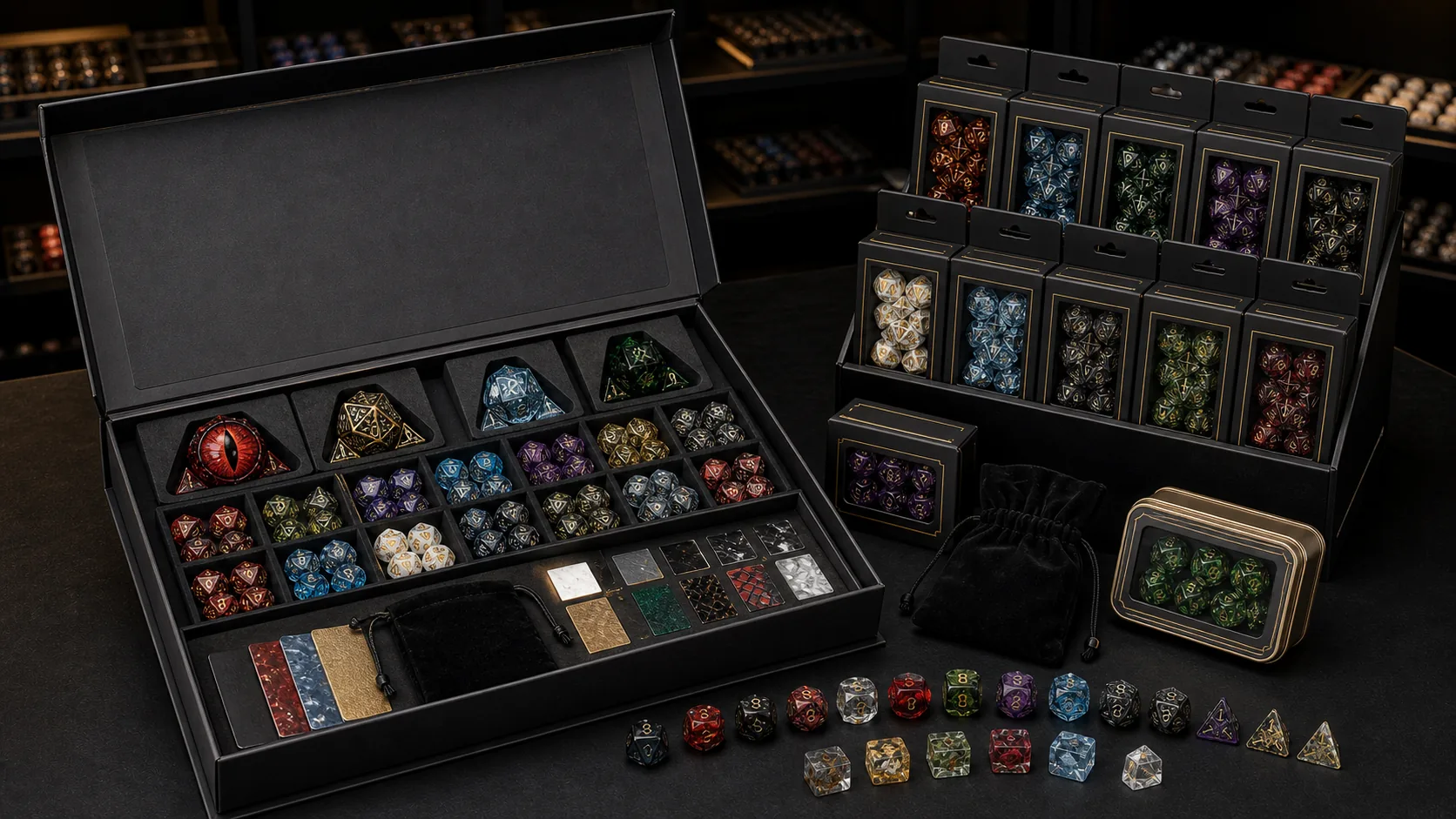
A sample kit can also help choose a practical direction before custom tooling. For example, the team may compare resin, sharp edge resin, metal, oversized d20, and packaging samples, then decide which option fits the reward budget. That is usually faster than asking for a full custom prototype before the core specification is stable.
5. Understand the production route before you approve the reward
A quote becomes easier to compare when the campaign team understands what happens after artwork approval. Custom dice are not made in one step, and resin and metal dice follow different manufacturing routes. The process below is a practical framework for discussing samples, quality checks, and delivery planning with a supplier.
| Dice route | Typical production steps | What the campaign team should approve |
|---|---|---|
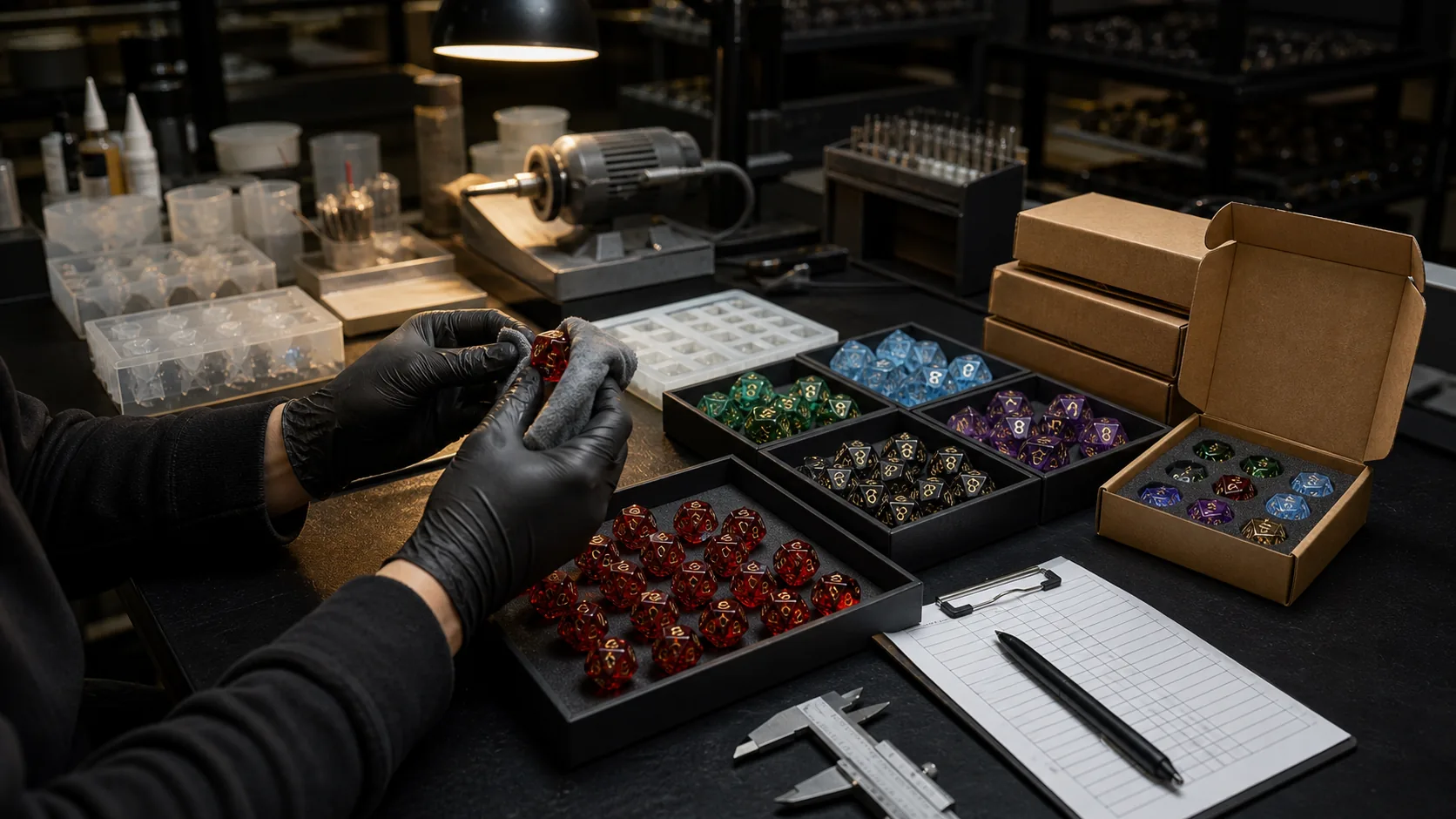
| Custom resin dice | Mold making, mold preparation, resin casting, polishing, laser engraving, coloring, inspection, and packaging | Color effect, surface clarity, number depth, number fill, logo readability, and final package fit |
| Custom metal dice | Die making, die casting, polishing, electroplating, coloring, inspection, and packaging | Weight, plating tone, edge finish, recessed detail, color contrast, protective packaging, and carton packing |
This distinction matters for Kickstarter planning. Resin is often easier to use for broad color variation and lightweight add-ons. Metal dice can support a premium collector tier, but their weight and surface finish make packaging and freight more important. A supplier that can explain the factory production process and show real quality-control checkpoints gives the campaign team more useful information than a product page with only a digital render.
Ask which features are confirmed by the sample and which are still subject to production tolerance. For example, a color can vary slightly between a screen render and a physical sample, while a small engraved symbol may need simplification to remain readable. Record the approved sample, artwork version, packaging dieline, and number-fill reference so the bulk order has a clear reference point.
6. Plan MOQ around realistic campaign scenarios
MOQ should be tied to pledge forecasts, not hope. A campaign can have a base case, target case, and stretch case. The dice plan should still work if demand lands in the middle. If the campaign only needs a few dozen sets, a standard catalog style with custom packaging may be safer. If the forecast reaches hundreds or thousands of sets, a deeper custom dice program becomes easier to justify.
Ask for MOQ by material and packaging separately. The MOQ for dice, the MOQ for a printed box, and the MOQ for a custom insert may not be identical. If the product is a stretch goal, check whether the supplier can hold the quote while campaign numbers are finalized. If the campaign will collect late pledges, explain that timeline because it can affect production scheduling.
7. Choose packaging that fits fulfillment
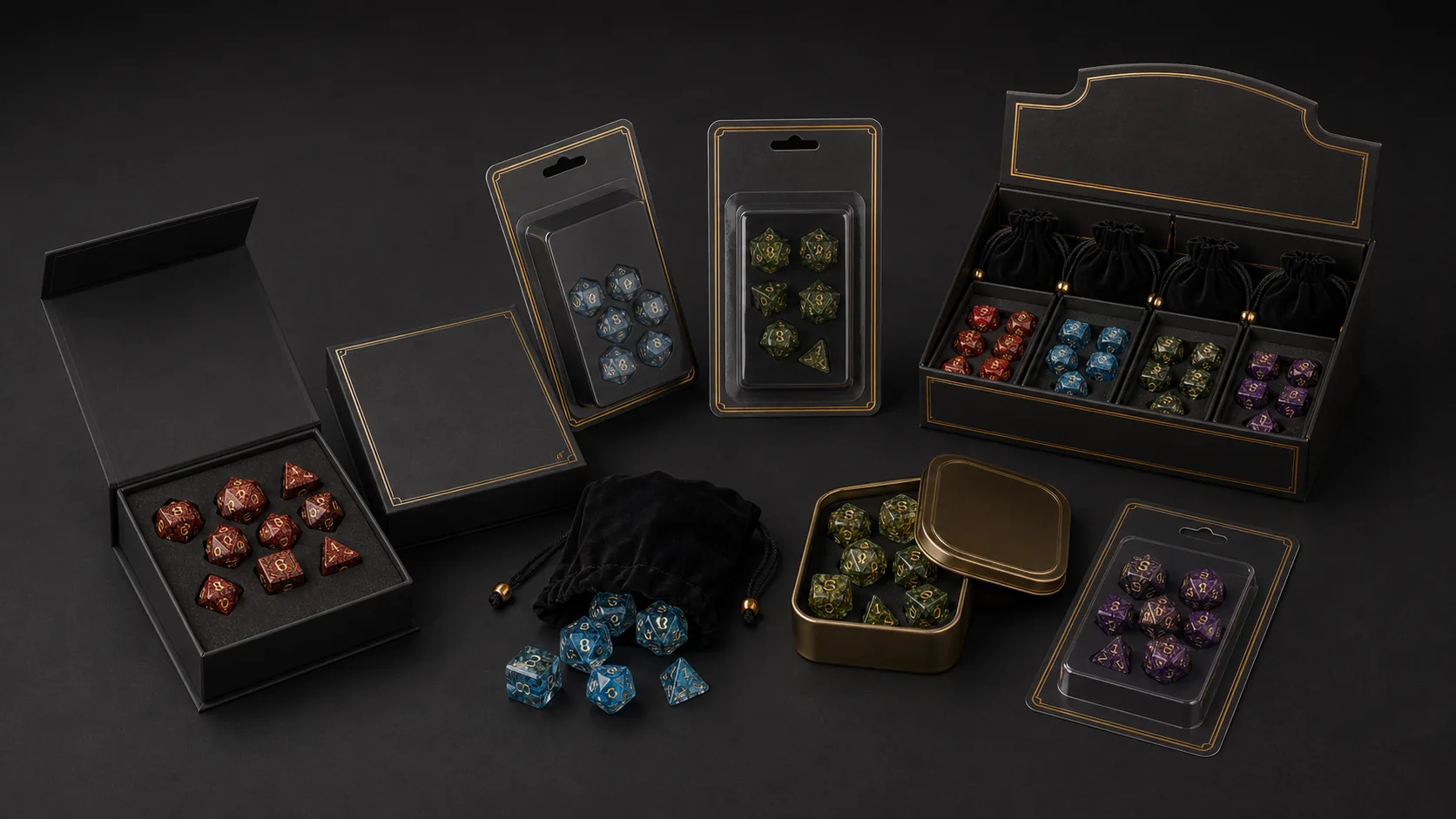
Packaging is not only a branding decision. It changes box size, shipping weight, protection, pick-and-pack speed, and how the reward is presented to backers. A velvet bag is compact and practical. A tin box improves perceived value and protects the dice better. A magnetic gift box or printed retail box can support premium tiers and retail sales after fulfillment.
For crowdfunding, the best packaging is the one that supports the whole plan. If the dice ship inside a larger RPG book box, compact packaging may be enough. If the dice ship alone as an add-on, stronger presentation and protection may be worth the cost. If the goal is retail distribution after the campaign, ask about barcode space, product name placement, logo position, warning text, and carton packing.
8. Build a campaign timeline before announcing delivery
A dice timeline usually includes specification confirmation, sample review, artwork adjustment, bulk production, quality inspection, packaging, export packing, shipping, and fulfillment center handoff. The exact schedule depends on material, quantity, packaging, and whether custom tooling is required.
Creators should avoid promising the fastest possible date. Leave room for sample revisions, campaign close, payment collection, survey completion, address locking, and freight movement. If the dice are part of a larger RPG book or box set, align the dice production plan with printing and assembly. A dice supplier can be fast, but the whole reward chain is only as fast as the slowest item.
9. Send a complete quote checklist
The fastest way to get a useful quote is to send a structured request. Include enough detail for the supplier to quote the real project rather than a generic dice set.
- Campaign type: Kickstarter, Gamefound, BackerKit preorder, retail launch, or convention release.
- Buyer type: RPG publisher, creator, dice brand, distributor, game store, or fulfillment partner.
- Dice type: resin, sharp edge resin, metal, liquid core, hollow, oversized d20, or mixed catalog set.
- Set format: 7-piece polyhedral set, d20-only, d6 pool, class set, dragon set, or custom assortment.
- Artwork: logo, custom d20 face, number font, color reference, symbol reference, and packaging art.
- Quantity target: sample kit, 100 sets, 300 sets, 1,000+ sets, or campaign-dependent range.
- Packaging: bag, tin, magnetic box, printed retail box, display carton, gift box, or private label format.
- Delivery: destination country, target ship date, launch date, and whether a freight forwarder is used.
When the request is clear, the supplier can respond with material options, MOQ direction, sample recommendation, packaging choices, and the questions that must be solved before production.
Custom Kickstarter dice FAQ
Are custom dice good Kickstarter add-ons?
Yes, custom RPG dice can work well as add-ons because they are easy for backers to understand and connect directly to character creation, campaign themes, faction identity, and collector rewards. The add-on works best when the material, packaging, MOQ, and shipping weight are planned before launch.
Should a first campaign choose resin or metal dice?
Resin dice are usually the more flexible starting point for color themes and broader pledge tiers. Metal dice can work well for deluxe tiers, limited editions, and high-value collector rewards, but they need stronger packaging and more careful freight planning.
Can I make one custom face on the d20?
Yes. A custom high-face symbol on the d20 is one of the most practical ways to create a campaign-specific dice set. Keep the symbol simple, readable, and supplied as vector artwork whenever possible.
Do I need final artwork before requesting a quote?
No, but you should send the closest concept available. Mark unfinished art as a concept and explain whether the quote should include dice only, packaging only, or both dice and private label packaging.
What is the safest way to plan MOQ?
Use a base case, target case, and stretch case. Ask for MOQ by dice type and packaging format so the campaign can handle different pledge results without changing the reward promise after launch.
What is the production route for resin and metal RPG dice?
A typical resin route includes mold making, casting, polishing, laser engraving, coloring, inspection, and packaging. A typical metal route includes die making, die casting, polishing, electroplating, coloring, inspection, and packaging. Ask the supplier which steps apply to the approved design and which checkpoints will be used before shipment.
Continue planning your RPG dice reward.
Kickstarter RPG Dice Use Case
Plan dice rewards, stretch goals, campaign samples, and quote information for crowdfunding teams.
Sample Kit & Catalog Request
Request catalog files and sample kit options before finalizing your custom dice brief.
Custom Dice Packaging
Compare bags, tins, magnetic boxes, printed boxes, display cartons, and private label packaging.
Prepare custom dice rewards before your campaign launches.
Send your campaign concept, target quantity, material preference, artwork files, and packaging direction. We can help compare sample kit options, MOQ paths, and private label packaging for custom RPG dice rewards.
Final planning checklist
Choose the reward role first, then choose the material. Keep custom artwork simple enough to manufacture clearly. Review samples before promising the final look. Confirm MOQ by dice and packaging format. Build enough production time into the campaign schedule. Most importantly, send a complete sourcing brief before launch so the dice reward supports the campaign instead of becoming a late production problem.